Rain Request Ritual in Old Tehran
According to the Mabalagh cultural and thought website, not long ago, when the sky was angry with the earth and rain was withheld from the people, Tehran residents would resort to an ancient ritual, intertwined with faith, religious, and popular beliefs; a ritual known in popular culture as ‘Rain Requesting’.
Jafar Shahri, in his book ‘Old Tehran’, provides a clear picture of this ritual in Qajar Tehran; a ritual in which people, with tears, prayers, poetry, and meaningful symbols, sought divine mercy from God.
According to Shahri, people would gather in circles in squares or outside the city gates and, with loud voices and mournful tunes, recite special prayers for rain. One of the most famous of these was attributed to Sheikh Abu Sa’id Abul-Khayr:
O Lord, send the cause of animal life,
From the ocean of generosity, send clouds of forgiveness.
For the thirsty lips of the children,
From the cloud-nanny, send the milk of rain.
This prayer symbolized the deep connection between people and nature and their belief in divine kindness; people regarded rain not merely as a natural phenomenon, but as a gift from the Almighty.
During the ceremony, seven pellets of ‘j’aleh’ or ‘camel dung’ were placed under a white copper bowl, symbolizing the purification of the earth and the awakening of mercy. Women, holding their children in their arms, would chant the nineteenth prayer of Sahifa Sajjadiyya in unison.
Papers were also hung on tree branches, each inscribed with one of the majestic names of God; a sign of trust and expectation of mercy.
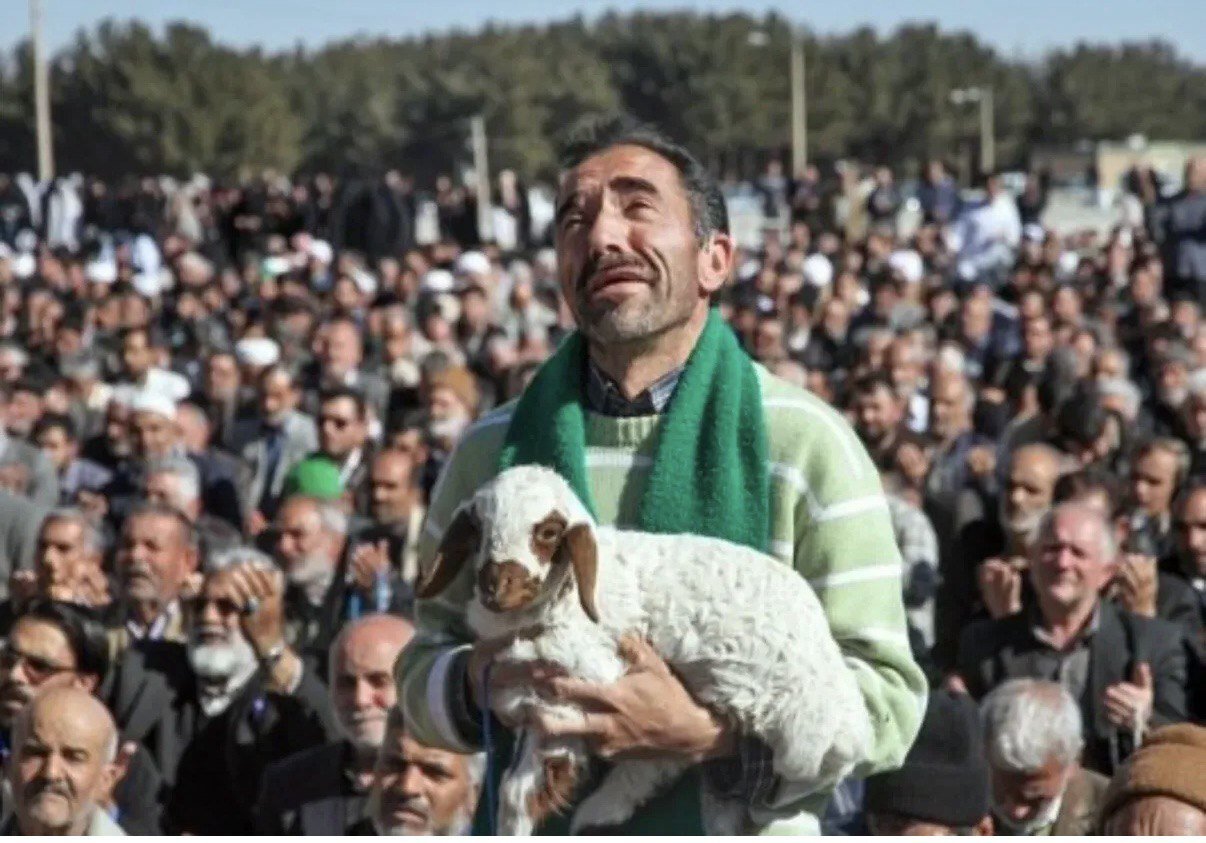
One of the most impactful parts of the ritual was bringing lambs and ewes to the ceremony ground. As a sign of empathy with the dry earth, the ewes were separated from their lambs so that their cries and laments would echo in the air. People believed that the tears and cries of animals reflected the land’s plight and softened the heart of the sky. In these moments, the lamentations of humans and animals intermingled, transforming the square into a vibrant place of worship.
Jafar Shahri writes:
‘They separated the ewes from their lambs and the hens from their chicks, and children from their mothers, so that cries and lamentations would rise and make the sky weep.’
The ‘Rain Requesting’ ritual in Old Tehran was not just a religious tradition; it was a symbol of the bond between humans, the earth, and God. People, with prayers and tears, sought mercy from nature and asked the Creator to re-establish peace between the earth and the sky.
In the present day, as Tehran grapples with water scarcity and drought, revisiting these rituals serves as a reminder of the profound meaning of prayer and collective empathy; that faith, even in its simplest popular form, can be a force for hope and resilience against drought.
Source: Shahri, Jafar. Tehran-e Ghadim. Tehran: Moein, 1376.