Shawariq al-Nusus: The Illumination of Truth on the Darkness of Forgery and Distortion
According to Mabalgh Thought and Culture website, prophetic hadiths and narrations have always been among the main sources of Islamic discourse and understanding throughout Islamic history. Each Islamic denomination and group has sought to establish its beliefs and rulings based on narrations from the Prophet (PBUH). Meanwhile, some scholars and narrators, due to personal biases and worldly desires, whenever they could not find a narration to prove their false beliefs, resorted to fabricating narrations and chains of transmission, not refraining from attributing any lie to His Holiness, the Seal of Prophets (PBUH).
The traces of this issue can even be found in the early era, as it has been narrated through authentic and reliable chains by both factions from the Commander of the Faithful (AS) that he said: «و قد کُذِبَ علی رسولِ اللّه ِ صلی الله علیه و آله علی عَهدِهِ حتّی قامَ خَطیبا فَقال: «أیُّها النّاسُ قَد کَثُرَتْ عَلَیَّ الکَذّابَةُ، فمَنْ کَذبَ عَلیَّ مُتَعمِّدا فلْیَتَبوّأْ مَقعدَهُ مِن النّار ثُمّ کُذِبَ علَیهِ مِن بَعدِهِ» (The meaning of his words is: During the Prophet’s lifetime, so many lies were attributed to him that he delivered a sermon and said: O people! Those who lie about me have multiplied; whoever intentionally lies about me, his place is in the Fire. Nevertheless, lies were attributed to him after the Prophet.)
According to an IQNA narration, this hadith shows the wide extent of hadith fabrication even during the lifetime of the noble Prophet of Islam (PBUH), let alone after his demise. When the train of Islam deviated from the track of Ghadir and swerved towards Saqifa, with people like Ka’b al-Ahbar coming to power and the prohibition of writing hadith, the field for narrators of fabricated hadith became wider than before.
Among these, one area where narration fabrication has always been significantly prevalent is the invention of virtues for certain companions and caliphs due to religious fanaticism, the establishment of certain theological views (such as the justice of companions), and personal affection for them. To illustrate this, we can refer to the fabricated hadith: «اصحابی کَالنُّجُومِ بِاَیِّهِمْ اقْتَدَیْتُمْ اهْتَدَیْتُمْ» (My companions are like stars; by whichever of them you are guided, you will be guided.) This hadith, according to many prominent Sunni scholars such as Ibn Hazm al-Andalusi (d. 456 AH), Ibn Hajar al-Asqalani (d. 852 AH), and even Salafis like Ibn Taymiyyah (d. 728 AH) and Nasir al-Din al-Albani (d. 1420 AH), is forged and invalid.
Because such fabricated hadiths have been used to reject the Shia school of thought and create doubts among ordinary Shias, Shia scholars have always striven to defend the integrity of their faith by clarifying thoughts and presenting their evidence for invalidating and disproving these hadiths. Many books have been written in this field, and undoubtedly one of the most effective and robust of these books is the noble work “Shawariq al-Nusus” (Flashes of Texts/Proofs), authored by Allamah Mir Hamid Husayn Hindi. Before delving into this book, its framework, structure, and contents, we will introduce his esteemed personality.
Allamah Mir Hamid Husayn Hindi was born in 1246 AH in the city of Kintoor, India, into a family of knowledge and virtue. His ancestors migrated from Nishapur to Kintoor, India, in the seventh century AH due to the invasion of Genghis Khan. His father, Sayyid Muhammad Quli, was himself one of the great scholars of his time, proficient in both rational and transmitted sciences. In addition to his significant efforts in preaching, guiding people, and solving their problems, he left valuable works in various fields of Islamic sciences such as exegesis, jurisprudence, hadith, debate, and more, demonstrating his mastery of all sciences. He also wrote works in defense of the Shia faith and in refutation of criticisms against it; in this regard, one can refer to the book “Al-Ajnad al-Ithna Ashariya al-Muhammadiyah fi Radd al-Tuhfa al-Ithna Ashariya” (The Muhammadan Twelver Soldiers in Refutation of the Twelver Gift). In this book, he responded to “Tuhfa Ithna Ashariya” (The Twelver Gift), which Abd al-Aziz Dehlawi had written to refute Imami beliefs, and tried to resolve the doubts raised in it.
Mir Hamid Husayn was one of the most prominent researchers and personalities of his era. As the translator of “Shawariq al-Nusus” states in his brief biography, Shia and Sunni scholars from various parts of Islamic lands corresponded with him to resolve some of their issues and problems. Regarding his works, it is mentioned that, according to Muhaqqiq Tabrizi, he authored over 200 volumes. Among his works, four have received more attention: “Abaqat al-Anwar fi Imamat al-A’immat al-At’har” (Fragrances of Lights on the Imamate of the Pure Imams) (refuting Abd al-Aziz Dehlawi’s “Tuhfa Ithna Ashariya,” which with the current printing method for its collection will exceed 100 volumes, and this book has been and continues to be highly regarded and used by scholars), “Shawariq al-Nusus” (Flashes of Texts/Proofs) (the central book of this article), “Al-Sharia al-Gharra” (The Radiant Law) (a complete course in demonstrative jurisprudence), and “Al-Dhara’i fi Sharh al-Shara’i” (Means in Explaining the Laws) (a book on demonstrative jurisprudence commenting on Muhaqqiq Hilli’s “Shara’i al-Islam” (Laws of Islam)). He passed away in his birthplace in 1306 AH and was buried there.
“Shawariq al-Nusus” and a Review of its Structure and Content
In the book’s introduction, the author elaborates on his purpose for writing it by addressing the seditions, deviations, and distortions that occurred after the Prophet’s (PBUH) demise, and he writes: “Thus, at this time – when indifference to the origin and the afterlife was prevalent among most members of society – slanders and unjust accusations against the sacred presence of the Prophet escalated, and lying, calumny, and presenting as real what had no reality became widespread among people… Every virtue and merit uttered by the blessed lips of the Seal of Prophets (PBUH) in praise of the Commander (AS) and his pure progeny (AS) was attributed to the caliphs and… they did not stop there, but rather fabricated false narrations whose content led to the degradation and humiliation of the stature and positions of the Commander of the Faithful and his noble progeny (AS). The attribution of these false narrations to the Messenger of God (PBUH) and their dissemination among people caused the Ummah to become oblivious and indifferent towards the Prophet’s household.”
He then refers to his resolve and writes: “Despite such a calamity, I decided to author a unique book in which I would prove how many hadiths in this domain were fabricated by the followers of the Caliphs’ school of thought and falsely attributed to the sacred presence of the Messenger of God (PBUH).”
Mir Hamid Husayn writes about his methodology in this book: “In proving the fabricated and invented nature of these false narrations, I presented evidence from the words and statements of their own prominent scholars, individuals who hold a very high status among the followers of Saqifa and whom Ahl al-Sunnah regard with reverence and respect.”
At the end of the introduction, while appreciating the activities of Imami scholars in addressing this topic in parts of their argumentative books concerning Imamate, he states that the distinguishing feature of his work is its focus on this subject and its independent treatment.
His methodology in this book is to first quote the narration, then examine its chain of transmission, narrators, and content, and finally present the views of prominent Sunni scholars regarding it. Through the conclusions drawn from these discussions, he proves that the hadith was not issued by the blessed presence of the Seal of Prophets (PBUH). Allamah Mir Hamid Husayn structured this book into three chapters:
- Some fabricated virtues and invented merits for the first Caliph.
- Some fabricated virtues and invented merits for the second Caliph.
- Some fabricated virtues and invented merits common to both the first two Caliphs.
The first chapter of this book includes 36 sections. In each section, the author critiques and examines one of his chosen fabricated narrations using the method described earlier. Among these hadiths are: the hadith of God’s manifestation to Abu Bakr, entering Paradise being conditional on loving Abu Bakr, Abu Bakr not being held accountable on the Day of Judgment, God Almighty appointing Abu Bakr as the successor of the Messenger of God (PBUH), and several other hadiths which the author declares utterly false.
In the second chapter, Mir Hamid Husayn analyzes 23 invented virtues of the second Caliph using the aforementioned method. Among the most important of these hadiths are: the possibility of Umar ibn Khattab holding the position of prophethood, the superiority of the second Caliph over others, the revelation of the Hijab verse according to Umar ibn Khattab’s opinion, and the fleeing of jinn and human devils from the second Caliph.
The final chapter of the book also comprises 13 common fabricated virtues between Abu Bakr ibn Abi Quhafah and Umar ibn Khattab and their refutation; such as: Abu Bakr and Umar are the best of the first and the last, those who hate Abu Bakr and Umar will not escape Hell, the Prophet (PBUH), Abu Bakr, and Umar were created from the same earth, and several other fabricated hadiths to prove the superiority of these two caliphs over others.
In conclusion, one must bow in respect to the meticulous analysis and precision of the esteemed Allamah Mir Hamid Husayn in scrutinizing these narrations and refuting them in defense of the true Shia faith. During the days of the martyrdom of Her Holiness Siddiqah al-Kubra (SA), by reading this valuable book, we can gain greater awareness of what she strived to defend throughout the period from the Prophet’s (PBUH) passing until her martyrdom—namely, the position and status of Commander of the Faithful Ali (AS) and maintaining Islam on the path established by the Seal of Prophets (PBUH)—and thus increase our knowledge of the Ahl al-Bayt of infallibility and purity (AS), so that our only benefit from these days is not weeping without understanding.
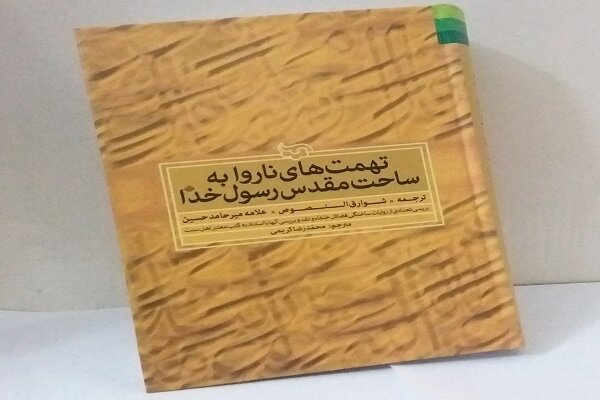
This book was published in spring 1400 (Solar Hijri) by “Dalile Ma” Publications under the title “Unjust Accusations against the Sacred Presence of the Messenger of God (PBUH),” translated by Mohammad Reza Karimi, reaching its fourth print and made available to those interested in the teachings of the Ahl al-Bayt (AS).